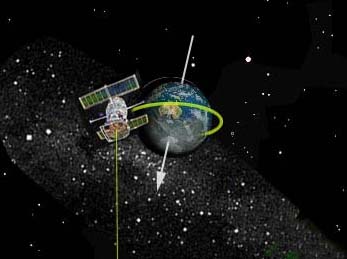
For continuous observation over ten days, a site near the south celestial pole was required. To obtain as clear a view as possible of objects in the far universe, a site away from the plane of the galaxy was required.
 HDF Index
The Hubble Space Telescope’s first deep probe into the heavens produced a unique gallery of thousands of faint galaxies, called the Hubble Deep Field. This long look into the cosmos was so successful that Space Telescope Science Institute astronomer Robert Williams decided to plan a sequel.
"I had wanted to undertake a second Deep Field shortly after the first," recalled Williams, who, as Institute director, used his discretionary time to make the original Hubble Deep Field observations in 1995. "When it became evident within a few months that researchers were drawing important conclusions from the data about the history of galaxy formation, I knew then that we had to conduct another Deep Field in a different area of the sky."
Williams also knew that one 10-day gaze into deep space wasn’t enough. The Deep Field was, after all, a relatively small sample of remote galaxies. And yet, the information these objects yielded strengthened astronomers’ knowledge of star formation and galaxy evolution. Astronomers, however, must study more faraway galaxies to assemble a clearer picture of our early universe.
They need another "core sample" of the sky. Basing conclusions on one sample of the heavens is similar to making judgements about the U.S. population by polling people who live along a 20 mile-wide strip from California to New England. To be reassured this was a representative "slice" of our country, researchers would want to make a second survey along a separate cross-continental strip.
|
For continuous observation over ten days, a site near the south celestial pole was required. To obtain as clear a view as possible of objects in the far universe, a site away from the plane of the galaxy was required. |
CHOOSING A LOCATION
For the sequel, Williams decided to go south. Picking a patch of sky in the Southern Hemisphere was fairly easy. The first time around, the Hubble telescope was pointed at a region of space in the Northern Hemisphere. So, for Hubble Deep Field Part 2, the southern sky seemed like a good choice. The southern region has a stable of powerful ground-based telescopes, including the European Southern Observatory’s Very Large Telescope in Cerro Paranal, Chile. These telescopes will make important follow-up observations to establish distances to the faraway galaxies.
Astronomers also needed a region where the Hubble telescope has an unobstructed view of the heavens. There are only a few locations where Earth doesn’t block the telescope’s view, and those are regions of space above Earth’s poles.
QUASAR ADDED TO THE PICTURE
For this second observation, Williams wanted to add a very bright object to the mix of distant, faint galaxies. His choice: a quasar. Quasars are extremely bright and very distant objects believed to be powered by black holes residing in the cores of galaxies. Most of these light beacons formed very early in our universe, and their light takes billions of years to reach Earth. As the light from these faraway cosmic light bulbs travels through space, it illuminates invisible clouds of gas, revealing the secrets of galaxy evolution. In fact, quasars are so important that their study became one of the key reasons for the construction of the Hubble telescope.
Williams and his team of 50 astronomers and technicians tapped an Australian observatory to hunt for one of those distant light beacons in the southern sky. Two summers ago astronomers at the Anglo-Australian Observatory in Siding Spring, Australia, discovered a quasar about 9.5 billion light-years away. The Deep Field team then selected a target area around the quasar in October 1997 and conducted test observations with the Hubble telescope to ensure they had proper guide stars to keep the orbiting observatory steady during a long observation.
THREE CAMERAS STUDY WIDER AREA
This time around the Deep Field team decided to broaden the observation by taking snapshots of a wider area: the target area and the region surrounding it. This broadened perspective is helpful for astronomers conducting follow-up surveys with ground-based telescopes.
The team used three Hubble telescope cameras to scrutinize this wider area: the Wide Field and Planetary Camera 2 (WFPC2), the Space Telescope Imaging Spectrograph (STIS), and the Near Infrared Camera and Multi-Object Spectrometer (NICMOS). Each camera specializes in gathering light from different areas of the light spectrum, from ultraviolet to infrared, and should provide astronomers with more information about remote objects.
Astronomers used only the wide-field camera during the original Deep Field observation. The infrared camera and the imaging spectrograph, which analyzes ultraviolet light, were placed aboard the telescope two years after the Deep Field campaign.
HUBBLE DEEP FIELD: THE SEQUEL
Two years after the initial planning, the Deep Field team was ready to make the observation. On Sept. 28, astronomers aimed the Hubble telescope on the same narrow slice of sky in the constellation Tucana. For two weeks, until Oct. 10, the telescope stared almost continuously at the same target, taking image after image in ultraviolet, optical, and infrared light. The observation consisted of 150 orbits of the primary field and 27 orbits of the flanking fields. The telescope snapped 995 exposures of the primary field. The average exposure time was 30 to 45 minutes. For the final pictures, astronomers combined several images to create the equivalent of a long exposure. These final images showcase a dazzling gallery of 2,500 galaxies.
The observation captured objects as dim as 30th magnitude, which is 6 billion times fainter than the human eye can see.
Astronomers used eight color filters to study the light from these distant objects. To understand stars and galaxies, astronomers must see them in different colors, which represent different sections of the light spectrum. By analyzing these colors, astronomers can, among other things, estimate the distances of objects, and their temperatures and velocities.
The wide-field camera collected light in near ultraviolet, blue, visible, and near-infrared wavelengths. Objects emitting light in infrared wavelengths was the focus of the infrared camera’s observations. By studying information at these longer wavelengths, astronomers can calculate how far light from distant objects has been stretched to longer wavelengths by the expansion of space. The camera also is adept at capturing stars hidden in dusty galaxies. Astronomers used the imaging spectrograph to make ultraviolet-light images of objects such as a galaxy’s hottest stars. The instrument also collected spectral information, which reveals the chemical composition of stars.
